How Many Days in Fes Do You Really Need? (2026 Travel Guide)
Quick Answer: How Many Days in Fes is Enough?1 Day in Fes: Quick Express Visit2 Days in Fes: Recommended Duration for First-Timers3 Day...


For centuries, travelers, scholars, and trade caravans have crossed rugged mountains and vast deserts only to stop in awe when catching their first glimpse of Fes el Bali. Founded in the late 8th century by Idris I, this sprawling, walled urban center is not merely a historic relic—it is a breathing, thriving, and deeply spiritual metropolis.
As a UNESCO World Heritage site and the largest contiguous car-free urban area on the planet, Fes el Bali comprises a staggering network of over 9,000 narrow, labyrinthine alleyways, hidden courtyards, majestic mosques, and ancient workshops. Stepping through its monumental gates is the closest a traveler can get to literal time travel. Mules and donkeys laden with goods still claim the right-of-way, artisans hammer raw copper using techniques passed down through generations, and the scent of orange blossom water mixes with the earthy aroma of freshly tanned leather.
Whether you are designing a high-converting landing page, crafting an authoritative blog post, or preparing an immersive guide for international travelers, this comprehensive, long-form guide covers absolutely everything a visitor needs to see, understand, and experience within the ancient walls of Fes el Bali.
The journey into Fes el Bali begins long before you reach its inner markets. The entire medina is encircled by massive, golden-hued ramparts punctuated by defensive towers and ornamental gates (Babs). These gateways act as physical and psychological portals separating the modern world from medieval Morocco.
The undisputed main artery into the old city is Bab Boujloud, widely known as The Blue Gate. Constructed in 1913 during the French protectorate era, it sits adjacent to a much older, more modest 12th-century gate.

While Bab Boujloud gets the most attention, exploring other entry points offers a more localized, less tourist-heavy perspective:

Fes has long been revered as the spiritual and intellectual capital of Morocco. This reputation was largely built during the Marinid Dynasty (13th to 15th centuries), an era characterized by a massive boom in the construction of medersas—theological colleges that doubled as student dormitories and mosques. These buildings showcase the pinnacle of Moroccan craftsmanship, blending three core elements: zellige tilework, hand-carved cedarwood, and intricate stucco plasterwork.
Built between 1451 and 1456 by the Marinid Sultan Abu Inan Faris, Medersa Bou Inania is widely considered the most spectacular religious monument in the city.
Tucked deep into the heart of the commercial district—right next to the spice markets—is Medersa Al-Attarine. Built by Sultan Abu Said Uthman in 1325, this school is smaller and more intimate than Bou Inania, but many architectural historians argue that its execution is even more refined.
No trip to Fes el Bali is complete without acknowledging its crown jewel of global education: the University of Al-Qarawiyyin (also spelled Al-Karaouine).
Founded in 859 AD by a wealthy, pious refugee woman named Fatima al-Fihri, Al-Qarawiyyin is recognized by both UNESCO and the Guinness World Records as the oldest continuously operating institution of higher learning in the world. Long before Oxford, Cambridge, or the Sorbonne were established, scholars from all over the Mediterranean—including Christian and Jewish philosophers like Pope Sylvester II and Maimonides—traveled to Fes to study astronomy, medicine, logic, and Islamic law.
Because Al-Qarawiyyin is an active, deeply holy mosque that can accommodate up to 22,000 worshippers, the interior courtyard and prayer halls are strictly reserved for Muslims. However, the experience for international tourists is still profound:
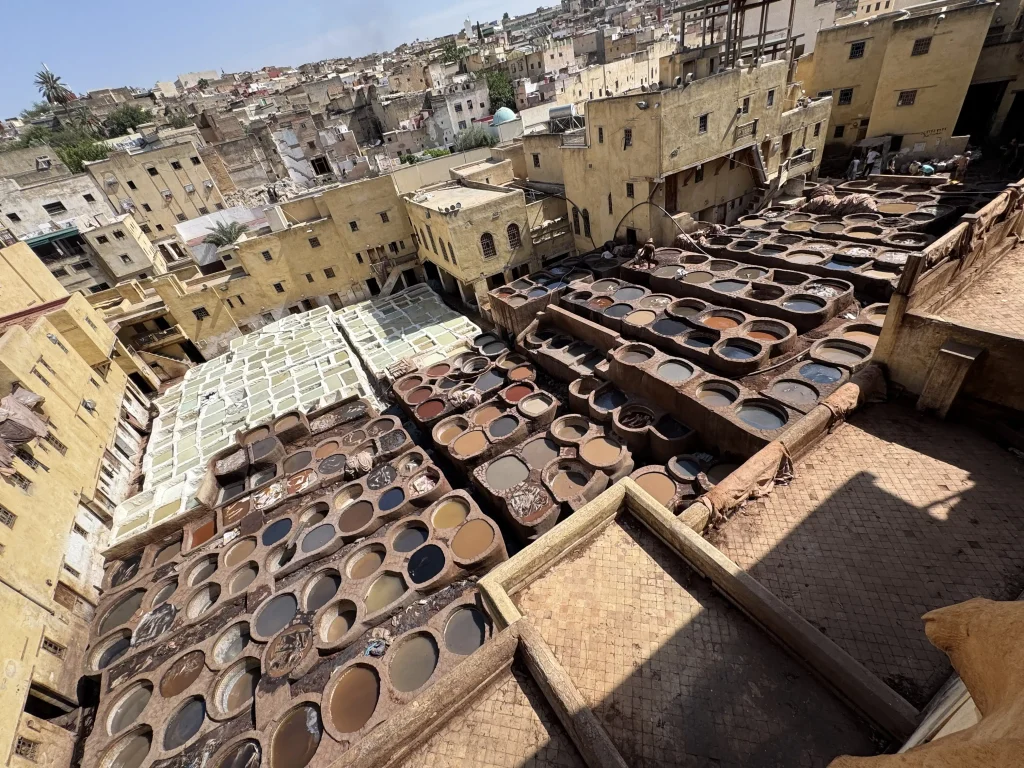
Fes el Bali is not an archaeological museum frozen in amber; it is an industrial town operating on medieval infrastructure. The city’s economy has been driven by artisan guilds for over a millennium, and nowhere is this more visceral than at the tanneries and metalworking squares.
+-------------------------------------------------------------+
|                      CHOUARA TANNERY                        |
|                                                             |
|   [ White/Grey Vats ] ----------> [ Colorful Dye Vats ]      |
|   Pigeon droppings & lime          Poppy (Red), Indigo (Blue)|
|   To soften the raw hides          Saffron/Turmeric (Yellow) |
+-------------------------------------------------------------+
Dating back to the 11th century, Chouara Tannery is the largest and most famous of the three ancient tanneries remaining in Fes. Here, leather is processed, softened, and dyed using organic, raw ingredients exactly as it was during the time of the Almoravids.

A short, winding walk from the tannery brings you to Place Seffarine, one of the oldest and most charming small squares in the medina.
Navigating Fes el Bali is easiest when you understand that the medina is organized into specialized markets (souks). Historically, the cleanest and most luxurious trades (like gold, perfumes, and silks) were located closest to the sacred Al-Qarawiyyin Mosque, while the noisier, smellier trades (like blacksmiths and tanners) were pushed toward the outer edge of the walls.
| Souk Name | Primary Goods Sold | Cultural Significance |
| Souk El Attarine | Spices, herbs, medicinal plants, henna | The sensory core; highly aromatic and colorful. |
| Souk Henna | Natural henna, cosmetics, black soap, clay | Used for centuries by women preparing for the Hammam. |
| Souk Nejjarine | Woodwork, furniture, traditional wedding thrones | Home to the spectacular Nejjarine Museum. |
| Souk Chemainne | Roasted nuts, dried fruits, local dates | Historically the center for candle makers and dry goods. |
Located within Souk Nejjarine is the Fondouk Nejjarine. A fondouk (or caravanserai) was a traditional roadside inn where traveling merchants and their pack animals stayed overnight.
For first-time international travelers, Fes el Bali can feel overwhelming. Sharing these practical, street-smart tips will add massive value to any travel itinerary or blog post.
The medina has two primary parallel streets that run down the slope of the hill from Bab Boujloud all the way to the Al-Qarawiyyin area:
If a traveler ever feels hopelessly lost, they simply need to look for the flow of foot traffic and ask a local vendor for “Talaa Kebira” or “Bab Boujloud.” Walking uphill will almost always bring you back to the main western gates, while walking downhill takes you deeper into the historic center.
Because the alleys are so complex, tourists are frequently approached by unofficial local youths offering to guide them or show them “a secret panoramic view.”
Fes el Bali is a deeply traditional, conservative holy city.

Fes el Bali is an unparalleled destination that captures the imagination of global travelers. By structuring your content around its monumental gates, scholarly history, and raw artisan industries, you create a highly compelling narrative that satisfies informational search intent while driving commercial bookings for customized Fez Guided Tours.
Answer: Yes, it is incredibly easy to get lost. With over 9,000 narrow, unnamed alleys and dead ends, Fes el-Bali is designed like a medieval labyrinth. While you can explore the two main streets (Talaa Kebira and Talaa Seghira) on your own, hiring an official licensed guide is highly recommended. A guide not only navigates the maze effortlessly but also unlocks the hidden history of the medersas, protects you from aggressive shopkeepers (faux guides), and ensures you don’t miss hidden gems like the Chouara Tannery terraces.
Answer: The absolute best months to visit Fes are during the spring (March to May) and autumn (September to November). During these shoulder seasons, the weather is pleasantly warm (ranging from 18°C to 26°C), making it perfect for long hours of walking.
Answer: To truly absorb the history and culture, you need at least one full day (6 to 8 hours) dedicated strictly to a guided walking tour inside Fes el-Bali. However, we highly recommend staying 2 to 3 days in Fes. This allows you to spend your first day exploring the old Medina, your second day visiting the historic Jewish Quarter (Mellah) and the Royal Palace gates, and your third day taking an unforgettable day trip to nearby historical landmarks like Volubilis, Meknes, or Chefchaouen.
Answer: Fes is considered the spiritual capital of Morocco and holds deeply traditional values. Visitors should dress modestly out of respect for the local culture. Both men and women should keep their shoulders and knees covered (avoid short skirts, sleeveless tops, or low-cut shirts). Additionally, because you will be walking several kilometers on centuries-old, uneven, and sometimes slippery cobblestones, wearing comfortable, closed-toe walking shoes with good grip is absolutely non-negotiable.